About PRISM
Member Powered Story - City of Fontana Unanimous Defense Verdict
Member Powered: We Are Ready
This series celebrates the experience, expertise and innovation found throughout PRISM’s membership. By sharing the challenges members have faced, the solutions they have developed and the lessons they have learned, this series highlights how public agencies are helping one another prepare for what comes next.
The Scene Ends. The Video Does Not: Lessons from Fontana’s Unanimous Defense Verdict
The encounter unfolded in seconds. Nearly five years later, jurors examined those seconds over the course of a 17-day trial.
They considered body-worn camera footage, reports, medical evidence, expert opinions and testimony about the circumstances confronting the officer at the scene. The trial ultimately concluded with a unanimous defense verdict for the City of Fontana.
For Susan Mendoza, Risk Manager for the City of Fontana, and Kayla N. Watson, Partner at Serviam by Wright LLP, the result reflected years of evidence preservation, careful analysis and close collaboration between the City and its legal representation.
A Brief Encounter Becomes a Five-Year Case
The incident occurred in October 2020, when an officer responded alone to a Fontana restaurant after a 911 caller reported a domestic disturbance involving three adults who had been drinking.
Before the officer could fully investigate the situation, the plaintiff drove away. A pursuit lasting approximately two minutes followed. When the plaintiff eventually stopped and exited his vehicle, the officer repeatedly instructed him to get on the ground. The officer then performed a controlled takedown, during which the plaintiff suffered a broken hip.
The central question in the lawsuit was whether the officer had used excessive force under the circumstances.
What happened in moments eventually led to nearly five years of discovery, depositions, expert analysis, policy review and pretrial proceedings. By the time Watson assumed responsibility for the case, it had already been continued multiple times and was approaching California’s five-year deadline for bringing a civil action to trial.
“When I was handed this case in late 2025, it was set for trial in March of 2026,” Watson said. “It had already had multiple continuances, and it was up against the five-year statutory deadline. It had to go.”
The case relied heavily on expert testimony. The defense retained six experts, while Plaintiffs identified seven retained experts and at least 17 non-retained experts, most of whom were expected to testify regarding Plaintiff Juan Gonzalez’s alleged permanent injuries, including a traumatic brain injury (“TBI”). The defense deposed every one of them.
A Deliberate Pretrial Process
Although the case was approaching its deadline, the court took a methodical approach to the pretrial issues.
The pace initially tested the patience of everyone involved. In hindsight, however, Mendoza and Watson believed the extended process helped narrow the issues and gave both sides time to closely examine the claims and supporting evidence.
On the eve of trial, the plaintiff withdrew his claim that he has suffered a TBI as a result of the incident. With the withdrawal of that claim, Plaintiff significantly limited his ability to present evidence that had been expected to drive much of the expert testimony and support his seven-figure damages request.
“That was just a game changer,” Watson said.
For public agencies, the experience demonstrates the value of carefully scrutinizing each claim rather than allowing the scale of a case or the number of experts involved to dictate its value. A disciplined pretrial process can expose weaknesses, limit unsupported evidence and bring the central issues into clearer focus.
Looking Beyond the Camera Frame
Body-worn camera footage became one of the defense team’s most important tools, but its use during opening statements was initially contested.
Watson successfully argued for permission to show the footage and had subtitles added so jurors could clearly follow the officer’s commands. She played the full recording during her opening and returned to relevant portions throughout the trial.
“The subtitles were key,” Watson said. “When you’re playing it without subtitles, jurors tend to get distracted by the background noise, and other things happening on the screen, rather than focusing on what was said.”
The footage allowed jurors to see and hear the encounter, rather than relying solely on competing descriptions of it. The officer’s testimony then supplied additional context. According to Mendoza and Watson, he presented as humble, credible and measured while explaining the decisions he made.
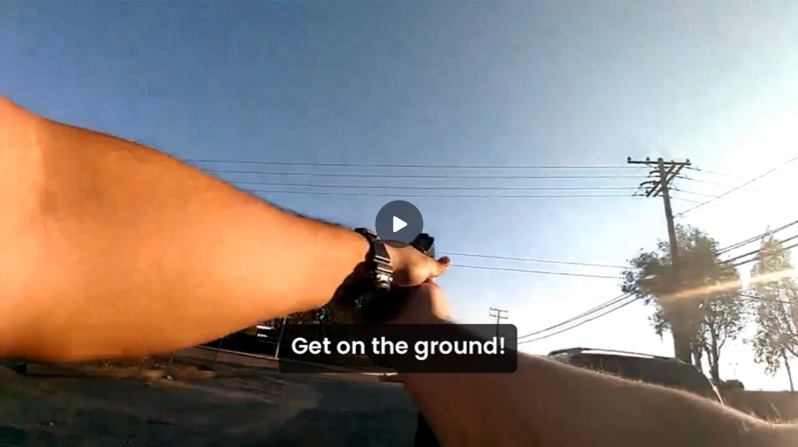
Subtitles helped jurors follow the commands captured by the officer’s body-worn camera.
The presentation also reinforced a broader lesson: body-worn camera footage can be powerful evidence, but it may not capture everything an officer saw, knew or perceived in real time.
Dispatch information, radio transmissions, incident reports, medical-aid records, policy documentation, supervisory actions and after-action reviews can all help establish that context. All may eventually be examined in detail by attorneys, experts, and jurors.
For agencies reviewing a critical incident, the defense team recommends considering:
- What information did the officer have in real time?
- What threats or risks were present?
- What relevant facts were not captured by the camera?
- What details should be documented in the report?
- What supervisory actions followed the incident?
- Which facts or omissions are likely to receive scrutiny during litigation?
“Leading up to trial, you have to make sure you have all of your evidence preserved,” Watson said. “One of the first things I always do is send out an evidence preservation letter and get all of that captured right away.”
Untangling the Damages
Organizing the experts and sorting through the damages materials submitted by the Plaintiff presented two of the defense team’s greatest challenges.
At trial, Plaintiff asked the jury to award $24.7 million in damages. Because Plaintiff had withdrawn his TBI claim, only one of his retained physicians testified regarding his hip surgeries and the projected cost of a future procedure. Plaintiff’s retained economist and life-care planner did not testify, significantly limiting the evidence presented in support of his claimed future medical expenses and lost earning capacity.
Plaintiff’s original hip surgery was performed through Kaiser and covered by his health insurance, resulting in a relatively nominal recoverable amount. He later underwent a second hip surgery performed by a physician to whom he had been referred by his attorneys and sought to recover approximately $200,000 for that procedure. However, Plaintiff did not call that physician to testify at trial, the approximately $200,000 claimed for the second surgery unsubstantiated by the evidence and never presented to the jury. The only physician Plaintiff called had never examined him and opined that a third hip surgery would be required in the future, projecting that the procedure would cost approximately $250,000.
In sum, Plaintiff was unable to substantiate most of his claimed and projected expenses. The medical expenses presented to the jury were limited to approximately $12,000 associated with his Kaiser treatment.
“Once we got to the end, so much of their claims had been whittled down,” Watson said.
The experience shows why public agencies should trace damages claims back to their supporting records. Medical projections, billed amounts, amounts accepted by providers and documented expenses may differ significantly and each claimed amount must be connected to admissible evidence.
A Late Social Media Discovery
Social media became another significant source of impeachment evidence.
The plaintiff’s wife had previously alleged loss of consortium, claiming that the injury had damaged the couple’s marital relationship. That claim was dropped before trial, limiting some of the impeachment evidence the defense had anticipated introducing.
However, the night before the wife was scheduled to testify about how the incident had materially affected him as a husband, father, and family man, Watson discovered a recent social media post indicating that the wife had become engaged to another man. Further investigation also raised questions about whether she and the Plaintiff continued to live together.
During cross examination, Watson confronted her with the social media post. The testimony significantly undermined the wife’s credibility and her account on direct examination regarding Plaintiff’s condition and family life.
After the verdict, a juror told Watson that the wife’s testimony had been a turning point in how the jury viewed Plaintiffs’ case.
“Always check the social media,” Watson said. “People who like to post all the time are going to overshare.”
The timing of the discovery also demonstrates why social media research should continue throughout litigation. A review conducted months earlier may not capture information posted immediately before a deposition or trial.
Presentation and Demeanor
The defense team emphasized that strong evidence still must be presented in a way jurors can understand.
That meant determining the order in which experts should appear, preparing witnesses and making complex evidence accessible. Subtitling the body-worn camera footage was one practical example.
It also meant considering the “calendar of life,” as Watson described it. Holidays, graduations and major community events can affect juror availability and attention during a lengthy trial. The attorneys considered those factors while navigating jury selection and the trial schedule.
Demeanor was equally important. Attorneys, witnesses and agency representatives must remain aware that jurors may observe their behavior in hallways, elevators and other shared spaces.
“You represent the county or the city,” Watson said. “You have to have a poise that is calm, collected and stern—but it is really about reading the room.”
That awareness also influenced the team’s decisions about when to object, when to challenge an argument and when to allow the opposing side’s presentation to stand on its own.
“You never want to go too far,” Watson said. “When you’re winning, take that win.”
For public agencies, professionalism is part of the case presentation. Representatives should understand the judge, consider the audience and approach the proceedings with the restraint expected of an organization serving the public.
Trust Between the City and Its Counsel
The City did not make a 998 offer before trial because its representatives and attorneys believed the evidence supported the officer’s actions. Plaintiff served a statutory offer to compromise under Code of Civil Procedure section 998 for $9 million, which he later reduced to $3.5 million. His wife, who remained a named plaintiff until she withdrew her loss-of-consortium claim on the eve of trial, separately served a section 998 offer for $250,000. The City declined the offers and proceeded to trial.
That confidence depended on a strong working relationship between Mendoza and Watson.
Mendoza attended the trial and participated in daily strategy discussions with the defense team. Together, they evaluated testimony, reviewed possible challenges and decided when further argument would strengthen the case, and when it was better to let the evidence speak for itself.
From the City’s perspective, Mendoza said having legal representation the agency could fully trust was essential.
“Kayla took over this case at the eleventh hour, but quickly dove into it headfirst and immersed herself in it,” Mendoza said. “She was tenacious, and she did not give up.”
Watson likewise credited their open communication with allowing her to remain focused on the trial.
“The last thing you want is to be worried that the client is unhappy with how the trial is going or wanted something presented that was not.” Watson said. “It is easy to get tunnel vision during trial, so having Susan there, working in the trenches alongside the defense team, made our presentation seamless and allowed me to remain focused on the next dau of trial. Susan and I worked so well together.”
PRISM Sr. Specialist, Katie O’Brien shared, "It's always a little nerve racking when it's clear a case is headed to trial. The relationships between Susan, Kayla, and myself made this case much less of a worry. Susan is always an outstanding partner who is responsive and approaches claims with a collaborative mindset. Although Kayla jumped into the case as trial counsel close in time to the trial, it was clear from our first call that she was fully up to speed on all aspects of the case. This allowed everyone to confidently participate in our strategy discussions and made a meaningful difference in the trial preparation process and, ultimately, the verdict. This claim demonstrates that when we work together, the strongest case can be presented and result in an excellent outcome."
The unanimous defense verdict was a significant victory for the City of Fontana and the named officer, and a well-earned result for the team that carried the case through years of litigation. The verdict confirmed the officer’s use of force was reasonable under the circumstances and reflected the preparation, persistence and sound judgment of the City and its defense counsel.
Sharing that experience is the purpose of Member Powered: We Are Ready. Every member victory carries lessons that can help another public agency preserve evidence, evaluate risk, strengthen partnerships and prepare for its own challenges. By opening the playbook behind this result, Fontana is helping turn one City’s success into knowledge that benefits the entire PRISM membership.
PRISM congratulates the City of Fontana, Susan Mendoza, Kayla N. Watson and the full defense team on this outstanding result. Their work demonstrates the strength of a member-powered community: experience shared, lessons carried forward and public agencies better prepared for what comes next.
You can view slides from Kayla's recent presentation on this case at the CPOA Conference here.